Monday, July 21, 2008

Commentary: Enter Friar Laurence - Act II Scene 3

Overview
  • The soil can be used for burying the dead and for growing plants.
  • Every creature no matter how lowly has a good use for the inhabitants of the earth.
  • But once they are used inappropriately then the consequences are unpredictable and dangerous.
  • Virtue used in the wrong context becomes its opposite: vice.
  • Vice can become a good thing when it is also used in the wrong context or "misapplied" for the purpose of good.
  • A plant can be used as both poison and medicine depending on how it is applied.
  • The willingness can be used for devotion to God or lust.
  • When there is too much lust the person dies.


The theme of Friar Laurence's rhyming soliloquy is that both good and bad are found in nature and people. The goodness or "virtue" in something is determined by how it is used or applied. He begins talking about the earth and mother nature:

The earth that's nature's mother is her tomb.
What is her burying grave that is her womb;


In other words:

The earth is both the mother of nature and the place where she is buried.
The place where she is buried is also the place where she produces life.

Friar Laurence tells us that both life and death is found in the earth. The earth is both the place where living things are buried, but also where they are born; that is, the earth is both the tomb and the womb of nature. This foreshadows the death of the two lovers (Act V Scene 3) which is, to say the least, tragic, but gives birth to the reconciliation between the two feuding families.

And from her womb children of divers kind
We sucking on her natural bosom find,
Many for many virtues excellent
None but for some, and yet all different


In other words:

From the soil, the earth's womb, a great variety of plants, the earth's children, are produced. By seeking food, or in Shakespeare's words, "sucking on her natural bosom" we discover a great variety of plants that are useful for a great variety of good things or "virtues". The word "virtue" was used up until the middle of the seventeenth century to denote the ultimate purpose of something, its final cause or its "finality"(Simon, 1986 p.74). Simon (1986) renamed it "existential readineness".


O mickle is the powerful grace that lies
In plants, herbs, stones, and their true qualities.
For naught so vile that on earth doth live
But to the earth some special good doth give;


In other words:

Oh how strong is the divine force in plants, herbs and stones and in their real properties. There is nothing so lowly and ugly living on earth that can't give some kind of special goodness back to those who live on the earth. This pre-empts the coming discourse on morality.

Nor aught so good but, strained from that fair use,
Revolts from true birth, stumbling on abuse.


In other words:

Everything is good, however once misused it acts in the opposite way from what it was intended and then faulters or collapses. Friar Laurence understands the principles involved and the dangers in manipulating the elements, he must be very sure he understands the qualities of all the elements and when one is abusing them or using them correctly. This is clearly applicable to science and the risks of manipulation.

Virtue itself turns vice being misapplied
And vice sometime's by action dignified


In other words:

By the same token when a virtue is not used in its proper sense it becomes evil. What's more, evil can sometimes become goodness when applied in certain ways. In summary an action can be either a virtue or a vice depending on how or in what context it is applied.

For the Greeks every action is aimed at some good. As Aristotle says in Book I of Nicomachaen Ethics:

Every art, and every science reduced to a teachable form, and in like manner every action and moral choice, aims, it is thought, at some good: for which reason a common and by no means a bad description of the Chief Good is, " that which all things aim at."

For Aristotle the goodness or rightness of an action was determined by how well it led the doer their goal. An action had to be carefully and rationally planned based on a clear understanding of the End and the moral rules necessary to realise it. It would be too much to say that Aristotle promoted the idea of the ends justifying the means. However this may be the meaning of Friar Laurence.

Within the rind of this weak flower
Poison hath residence and medicine power.


In other words:

In the skin of this fragile flower poison and medicine can be found.

For this, being smelt, with that part cheers each part;
being tasted, stays all senses with the heart.


In other words:

If sniffed it is beneficial, if tasted it is fatal. A plant is poisonous or medicinal depending on how it is applied.

Two such opposed kings encamp them still
In man as well as herbs – grace and rude will


In other words:

Willingness (Spencer, 1996) or readineness to act (Simon, 1986) can lead to grace or rude will depending on how it is applied. For Simon (1986) there is 'qualitative readiness' and 'existential readiness'. The former is knowledge and skills to do something. The latter is the willingness to do it. This willingness or readiness is something that can be apllied for good or bad purposes. Grace and rude will are equal and opposite.

This is relevant to science and ethics. Students are developing qualitative readiness through their studies. A course of ethics or ethical reflection is necessary to develop existential readiness.
Is this the same thing in NE?
Aristotle calls readiness to act as Hexis/Habitus/Disposition

And where the worser is predominant,
Full soon the canker death eats up that plant


In other words:

And where rude will or lust is dominant very quickly the cankerworm will consume the plant. In this context the plant is the metaphor for the body and the canker death the metaphor for some destructive force that will lead to the death of the body.

Friar Laurence seems to believe that the principle he describes of the relativity of goodness in nature is applicable to plants and vice versa. Armed with this he is ready to meddle in the affairs of the two lovers.

From examples of nature, Friar Laurence believes that death is not only part of life but necessary for life. Death can be viewed positively because it leads to life. He goes on to say that all life forms no matter how ugly and insignificant have something positve and beneficial for the inhabitants of the earth. He takes the example of a flower to illustrate the point that good and bad is found together in the same entity depending on how it is applied. Willingness in people can be used for grace or doing the will of God or for lust. If lust predominates over grace then the human body will die.

Vocabulary

aught: anything, all, everything : "aught I care"
bosom: breast
divers: diverse
grave: hole in the ground where a dead body is placed
None but for some: All plants have some use. (Spencer, 1967).
tomb: ornate above ground structure in which a dead body is placed
womb: the uterus, the part of a woman's body in which a baby develops

References

Levenson, , J.L (2000) The Oxford Shakespeare Romeo and Juliet.

Nicomachaen Ethics - Aristotle. Translated by D.P.Chase, 1911, Aristotle's Ethics. Dover Thrift Editions, New York

Russel, Bertrand (1996) History of Western Philosophy. Routeledge Classics.

Simon, Y. (1986) cited in Joseph Malikail MORAL CHARACTER: HEXIS, HABITUS AND 'HABIT', Minerva - An Internet Journal of Philosophy Vol. 7 2003.

Spencer, T.J.B (1996) Romeo and Juliet by William Shakespeare. The New penguin Shakespeare. London.

©All copyright, Ray Genet 2008


Tuesday, June 24, 2008

*Enter Friar Laurence : Act II Scene 3 lines 1-26

FRIAR:

Now, ere the sun advance his burning eye,

The day to cheer and night's dank dew to dry,

I must up-fill this osier cage of ours

With baleful weeds and precious-juiced flowers.

The earth that's nature's mother is her tomb;

What is her burying grave that is her womb,

And from her womb children of divers kind

We sucking on her natural bosom find:

Many for many virtues excellent,

None but for some and yet all different.

O, mickle is the powerful grace that lies

In herbs, plants, stones, and their true qualities:

For nought so vile that on the earth doth live

But to the earth some special good doth give,

Nor aught so good but, strain'd from that fair use,

Revolts from true birth, stumbling on abuse.


Virtue itself turns vice, being misapplied;

And vice sometimes by action dignified.

Within the infant rind of this weak flower

Poison hath residence and medicine power:

For this, being smelt, with that part cheers each part;

Being tasted, slays all senses with the heart.

Two such opposed kings encamp them still

In man as well as herbs, grace and rude will;

And where the worser is predominant,

Full soon the canker death eats up that plant.

Back to Romeo and Juliet Class Project - Instructions

Saturday, April 5, 2008

Queen Mab and The Interpretation of Dreams - in prep

Vocabulary

Use the Merriam-Webster's Online Dictionary to help you define the following words:

midwife
alderman
agate-stone = chalendony - a type of quartz
fore-finger
hazel nut
joiner
grub
spinners (plural noun)
spokes (noun)
traces (plural noun)
whip
lash
film
gnat

Commentary:

...the fairies' midwife

A midwife is someone who helps a mother give birth. Spencer (1967) thinks that this person does not help fairies give birth but she assists people give birth to dreams

In shape no bigger than an agate-stone
On the fore-finger of an alderman,

'The agate-stone' refers to a seal ring of an English state offical. The stone was usually engraved with a figure, and Queen Mab is about the size of this image (Spencer, 1967 p.192).

Drawn with a team of little atomies

A chariot is drawn (from the verb 'to draw') or pulled by a team or a group of horses. In this case the carriage of Queen is pulled by little atomies or "tiny creatures" (Spencer, 1967 p.193).

Made by the joiner squirrel or old grub

The squirrel gnaws the hazel nut and sculpts like a joiner or cabinet maker, while the grub or woodworm bores holes in it (Spencer, 1967, p.193).

Time out o'mind the fairies' coachmakers

I presume 'Time out o'mind' means something like 'time immemorial' or 'prehistoric' or 'long beyond memory'', although I have never heard this expression before. So, here the fairies' coachmakers, who are squirrel and grub, have been making coaches since time immorial or longer than anyone can remember.

The traces the smallest of spider's webs

The traces are the chains, ropes or leather straps used to attach a horse to a carriage. Here the straps of Queen Mab's carriage are made of a spider's web.

Her wagoner a small grey-coated gnat,

Not so big as a round little worm

Prick’d from the lazy finger of a maid;

The person who drives her coach is a gnat who wears a grey coat. It is about the same size as a maggot that develops is prick'd or removed with a pin or a needle from a lazy servant's finger. According to Spencer (1967) it was the common saying of Shakespeare's day that maggots, or the larvae of flies, would grow in the hands of indolent serving girls.

O’er courtiers’ knees, that dream on curt’sies straight,

A courtier is someone who flatters and/or is a member of a royal court.


ROMEO
I dreamt a dream tonight.
MERCUTIO: And so did I.
ROMEO: Well, what was yours?
MERCUTIO: That dreamers often lie.
ROMEO: In bed asleep, while they do dream things true.
MERCUTIO:
"O, then, I see Queen Mab hath been with you.
She is the fairies’ midwife, and she comes
In shape no bigger than an agate-stone
On the fore-finger of an
alderman,
Drawn
with a team of little
atomies
Over men’s noses as they lie asleep;
Her chariot is an empty
hazel-nut
Made by the joiner squirrel or old grub,
Time out o’ mind the fairies’ coachmakers.
Her wagon-spokes made of long spinners’ legs,
The cover of the wings of grasshoppers,
The traces of the smallest spider’s web,
The collars of the moonshine’s watery beams,
Her whip of cricket’s bone, the lash of film,
Her wagoner a small grey-coated gnat,
Not so big as a round little worm
Prick’d from the lazy finger of a maid;
And in this state she gallops night by night
Through lovers’ brains, and then they dream of love;
O’er courtiers’ knees, that dream on curt’sies straight,
O’er lawyers’ fingers, who straight dream on fees,
O’er ladies ‘ lips, who straight on kisses dream,
Which oft the angry Mab with blisters plagues,
Because their breaths with sweetmeats tainted are:
Sometime she gallops o’er a courtier’s nose,
And then dreams he of smelling out a suit;
And sometime comes she with a tithe-pig’s tail
Tickling a parson’s nose as a’ lies asleep,
Then dreams, he of another benefice:
Sometime she driveth o’er a soldier’s neck,
And then dreams he of cutting foreign throats,
Of breaches, ambuscadoes, Spanish blades,
Of healths five-fathom deep; and then anon
Drums in his ear, at which he starts and wakes,
And being thus frighted swears a prayer or two
And sleeps again.
This is that very Mab
That plaits the manes of horses in the night,
And bakes the elflocks in foul sluttish hairs,
Which once untangled, much misfortune bodes:
This is the hag, when maids lie on their backs,
That presses them and learns them first to bear,
Making them women of good carriage:
This is she—"

ROMEO: Peace, peace, Mercutio, peace!
thou talkst of nothing.

MERCUTIO:
True I talk of dreams;
Which are the children of an idle brain,
Begot of nothing but vain fantasy;
Which is as thin as air,
And more inconstant than the wind, who woos
Even now the frozen bosom of the North
And, being angered, puffs away from thence,
Turning his side to the dew-dropping South


Film versions Queen Mab Speech

Romeo and Juliet Act I Scene 4
Zeffirelli's version on Youtube From minute 1:01
Lhurmann's version on Youtube from minute 1:57 -4:43


Compare Mercutio's thesis on dreams and that of Freud's, and contemporary researchers.


Refer to The Interpretations of Dreams (1900) by Sigmund Freud

Key concepts:

  • wish fulfillment - desires are symbolised
  • dreams and day dreams have much in common
  • repressed wishes come out in dreams because it is safer that way
  • dream contents: latent(symbolic); manifest content (obvious and direct)
  • socially disturbing wishes are highly symbolic and difficult to interpret
  • dream may protect the mind from conflict in the subconscious

p255 Barron's Toefl

Compare with Activation Synthesis Theory - Hobson, A. and McCarley (1977) claim that dreams have no meaning at all. They are created by neural firings in an area in the brain called the pons. The mind just strings the impulses together in some kind of order.

The problem with Activation Synthesis Theory is that people with a damaged pons still dream. This suggests that it is higher brain function that cause us to dream and this lends credance to Freuds' theories.See Guardian Article 2004 Field of Dreams for an up to date overview of the theory of dreams.

Nevertheless, Mercutio appears to agree with both Freud and Hobson & McCarley. He sides with Freud, who proposed that dreams were wish fulfillmentin, in saying that lovers dream of love, soldiers dream of cutting foreign throats and so on. He also agrees with Hobson & McCarley, who claim that dreams are just the mind's attempt to piece together random information.

Lecture: G. William Domhoff - "The Awesome Lawfulness of Your Nightly Dreams" UC Santa Cruz Music Recital Hall - on Youtube

Listen to the introduction to Domhoff's lecture and say what he thinks of the work of Freud, Jung and Hobson & Mcarley.


Freud and Jung interpreters of metaphor

no emperical support for their ideas

the Activation Synthesis Theory completely wrong

Return to Romeo and Juliet Instructions

References

Spencer, T.J.B (1967) Romeo and Juliet by William Shakespeare. The New Penguin Shakespeare

Back to Romeo and Juliet Class Project - Instructions

Monday, August 20, 2007

The Sonnet - Romeo and Juiet Act I Sc. 5

Saints do not move though grant for prayers' sake

Exercise 1 Understanding Romeo and Juliet's First Meeting

1)Examine the sonnet from Act I Sc. 5 of Romeo and Juliet presented below and try to determine the rhyming pattern. To do this read the last word of every line.
2)Then count the number of syllables per line.
3) Read a line out loud and say where you think the stress falls; is it on the first or second syllable?
4) The text is divided into 4 colored parts (the colors are arbitrary). The class should be divided into groups. Each group is responsible for paraphrasing one of the four sections of the sonnet. This should take around 20-30 minutes. Once the paraphrase is completed students should present it to the class.
5) Once you have heard all the paraprhases from your classmates in your groups consider what metaphors are used.
6) How are these conflicting metaphors reconciled?


Act I Scene 5


ROMEO [To JULIET] If I profane with my unworthiest hand
This holy shrine, the gentle fine is this:
My lips, two blushing pilgrims, ready stand
To smooth that rough touch with a tender kiss.


JULIET Good pilgrim, you do wrong your hand too much,
Which mannerly devotion shows in this;
For saints have hands that pilgrims' hands do touch,
And palm to palm is holy palmers' kiss.

ROMEO Have not saints lips, and holy palmers too?

JULIET Ay, pilgrim, lips that they must use in prayer.

ROMEO O, then, dear saint, let lips do what hands do;
They pray, grant thou, lest faith turn to despair.


JULIET Saints do not move, though grant for prayers' sake.

ROMEO Then move not, while my prayer's effect I take.

Watch this scene from Franco Zeffirelli's 1968 film version of Romeo and Juliet using Youtube: http://www.youtube.com/watch?v=l1yIn5UNS1k

Exercise 2: The Picasso Effect and the Sonnet

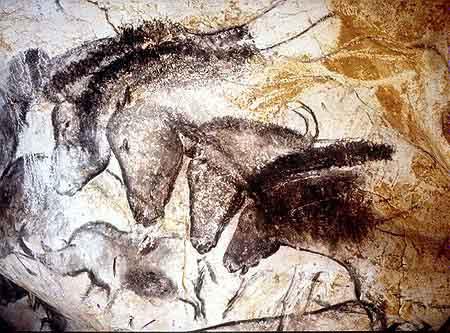
The variable surface of the walls of a cave can act as bas-relief for cave paintings See the image of horses from the Chauvet caves in France discovered in 1994. The image is older than 30, 000 years: http://www.donsmaps.com/images/horse.jpg

One could wonder what possible underlying natural structure was used to construct this sonnet. See if you can identify it.

Answers to come...

Back to:

Romeo and Juliet Class Project - Instructions

Back to:

Nature, Art & Language

© All Copyright, 2007, Ray Genet

Saturday, August 18, 2007

Introduction, Film Versions and Prologue

  • Skills: Listening and Writing, Paraphrasing, Writing a summary, Writing paragraphs, Shakespeare in English, Participating in an academic seminar, Giving a professional presentation,Thinking laterally and creatively
  • Language: similie, analogy, metaphor, as if, like, of, is analogous to,
  • Scientific themes drawn from this exercise: The preservation of form beyond constituents, the importance of metaphor and analogy in science.


Let's begin!

Part 1


Read the prologue and answer the questions that follow
ACT I

THE PROLOGUE


***

Questions

1. How many lines are there?
2. How many syllables per line are there?

3. What is the rhyming pattern? (Look at the last word of each line).

4. What kind of poem is the prologue?

5. What does the prologue tell us?

6. Why does it tell us so much?

7. Work in pairs and paraphrase just one line of the prologue. Your teacher will assign a line to you

The Films

Watch two film versions of the prologue: Franco Zeffirelli's 1968 production and Baz Luhrman's 1997 version on Youtube.

Youtube links: Romeo and Juliet 1968 - To minute 1:13; Romeo+Juliet 1996 - To minute 2:34
After having watched them do the following tasks for homework:

A) Compare the treatment of the prologue in the two film versions. What is the same and what is different about them? Explain what you think were the intentions of the directors. Which one do you prefer and why?

Part 2. The Civil Brawl - Act 1 Scene 1

Part 3


B) In your own time watch the a film version of Romeo and Juliet. Most public libraries carry copies for lending. Do not be surprised if you find it difficult to understand. This is perfectly normal as even most English speakers have difficulty understanding the antiquated language of Shakespeare. The objective of this exercise is to try to get a general understanding of the 'gist' or what is essential in the play. Once you have done this :


Write a 2-3 paragraph summary of the main events of the play.

For details about paragraph structure see Sophie's World: Writing Paragraphs


Romeo and Juliet homepage

Nature, Art & Language


© All Copyright, 2007, Ray Genet